
Active Warrants in Galveston County
Warrants in Galveston County are issued by judges and magistrates and then assigned to law enforcement to serve. The Sheriff's Fugitive Apprehension Division works warrants countywide and partners with the U.S. Marshal's Gulf Coast Violent Offenders Task Force, with investigators deputized as U.S. Marshals. The Constable for Precinct 4 handles many warrants issued by Justice of the Peace courts, most of them tied to Class C misdemeanors such as traffic, public intoxication, or minor offenses.
Once a warrant is received, it is date and time stamped and assigned to a warrant deputy. The deputy may mail a warrant notice, contact the wanted person, and check the county jail system to see if the person is already in custody. The Sheriff's public wanted list is the front door for the public, though it does not include every sealed or out-of-county warrant.
The Sheriff describes its warrant work on a dedicated division page. The Sheriff's Fugitive Apprehension page explains how Galveston County warrants are assigned and served.
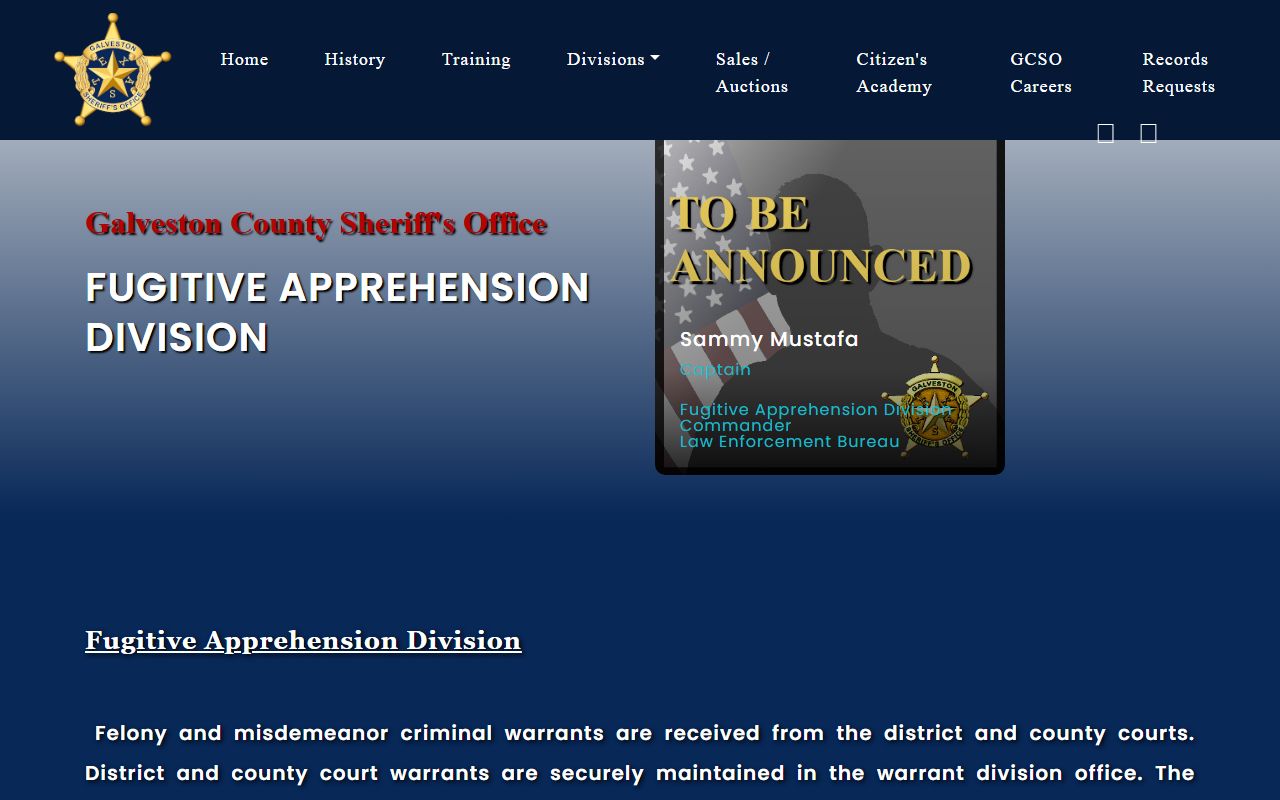
For Sheriff's Office warrants, the county lists a direct phone line, covered in the steps below.
How does a warrant reach a public list? A judge signs it, the order goes to the holding agency, and active items can appear on the Sheriff's wanted list. But the list is a snapshot. New warrants take time to post, and a warrant that has been served, recalled, or cleared may still show for a while. Sealed and out-of-county warrants may never appear at all. So treat the public list as a starting point, not the final word on whether a warrant is active.
Types of Warrants in Galveston County
Not every warrant means the same thing. The reason a warrant was issued shapes how you resolve it. A traffic warrant is handled very differently from a felony arrest warrant, so read the paper type and charge before you act.
- Arrest warrant - issued by a magistrate or judge on a complaint, directing officers to arrest a named person.
- Bench warrant or capias - issued after a missed setting, contempt, a bond problem, or a probation issue.
- Capias pro fine - used in fine-only cases after judgment when fines and costs remain unpaid; common in traffic and Class C matters.
- Search warrant - authorizes a search or seizure rather than an arrest; some affidavits may be sealed.
- Blue warrant - a parole-board warrant, which appears in the jail population as its own category.
The Sheriff also handles fugitive and out-of-county warrants, where extradition or a hold depends on the issuing jurisdiction. An immigration hold can also appear in jail data as a custody category rather than a county criminal charge, so read a hold differently from a county conviction.
Which Court Issued the Warrant
The court that issued a warrant controls how you clear it. That is the single most important fact to pin down. A Galveston County warrant can come from a Justice of the Peace court, a city municipal court, a county court at law, or a district court, and each handles its own recalls.
Justice of the Peace and municipal courts issue most fine-only and Class C warrants, including traffic failures to appear. County courts at law and district courts issue warrants tied to misdemeanor and felony cases, often as a capias after a missed setting or a bond problem. The Constable for Precinct 4 serves many JP warrants, while the Sheriff's Fugitive Apprehension Division works the more serious ones. Match the paper type and the issuing agency on the listing to the right court, then call that court rather than guessing.
How to Search Galveston County Warrants
The Sheriff's P2C Wanted List is the public tool. It shows a grid of wanted individuals and lets you jump by last-name letter or open a printable full list. The grid can be filtered by name, race, sex, age, paper type, and agency. It carries a disclaimer that age is based on the event date, not the current date.
- Open the Sheriff's P2C Wanted List page.
- Use the A-Z last-name links, or open the filter to search by name and other fields.
- Review the charge, paper type, address, and agency shown for each row.
The wanted list is built as a public grid. The P2C Wanted List is the Sheriff's official source for a Galveston County warrant search.
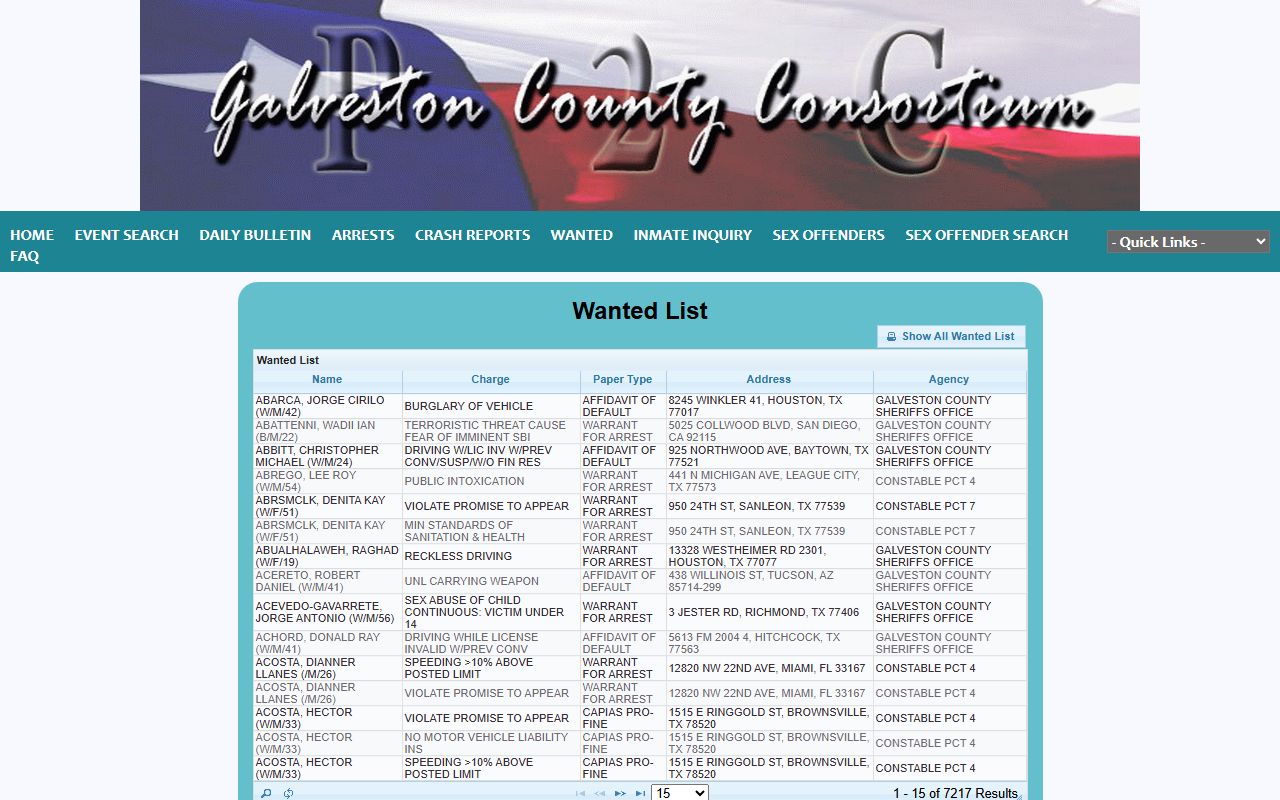
Rows in the public grid are not selectable, so the list shows summary fields rather than a full warrant detail page.
Galveston County Warrant Search Fields
The wanted list combines visible columns with hidden filter fields. The last-name letter links are the simplest way in, while the advanced filter opens the rest. The table lists the fields the grid supports.
| Field Label | Type | Required | Notes |
|---|---|---|---|
| Last Name | Text / A-Z links | No | Jump by first letter or filter the grid |
| First Name | Text | No | Advanced grid filter |
| Middle Name | Text | No | Advanced grid filter |
| Race | Dropdown | No | Options load from the grid handler |
| Sex | Dropdown | No | Options load from the grid handler |
| Age | Text | No | Based on event date, not current date |
| Paper Type | Dropdown | No | Warrant or paper category |
| Agency | Dropdown | No | Issuing or holding agency |
What a Galveston County Warrant Record Shows
Because the public grid is a list rather than a detail page, the fields it returns are summary fields. They tell you enough to identify a match and find the right agency, but not the full court file. The table maps each visible field to what it shows.
| Field | What It Shows |
|---|---|
| Name | The wanted person's name as listed by the agency. |
| Charge | The offense connected to the warrant. |
| Paper Type | The kind of warrant or paper on file. |
| Address | An address tied to the listing, where shown. |
| Agency | The agency that issued or holds the warrant. |
Note: the wanted list is not a substitute for the issuing court, which controls whether a warrant is still active or has been recalled.
What to Do If You Have an Outstanding Warrant
Finding your name on a warrant list is stressful, but there are clear steps. The key is to deal with the court or agency that issued the warrant, not a third-party site. Online lists can lag, so a warrant may need a court order, bond, payment, surrender, or recall before it clears. Acting early, before an officer makes contact, usually gives you more options for bond and scheduling.
- Identify the issuing court or agency, whether it is a JP, municipal, county, district, or Sheriff warrant.
- For Sheriff's Office warrants, call (409) 766-2300; to check jail custody, call (409) 766-2315.
- For a JP, traffic, or Class C warrant, contact the court named on the citation.
- Ask whether bond, fine payment, an appearance, an attorney filing, or surrender is required.
- If you have a lawyer, have counsel contact the court before you appear.
- After you act, confirm the warrant recall or clearance with the issuing clerk.
Important: Talk with a lawyer before turning yourself in, because the right path can depend on the warrant type, the charge, and your bond options.
Crime Stoppers and Anonymous Tips
The Galveston County Sheriff's Office takes anonymous tips through its Crime Tips line at (866) 248-8477. Tips can help locate a wanted person, and the Sheriff's site links these reporting tools alongside the wanted list. The Fugitive Apprehension Division and its U.S. Marshal task-force partnership focus on serious and violent fugitives.
Do not try to detain a wanted person yourself. Report what you know to the Galveston County Sheriff or the issuing agency and let trained officers handle the arrest. Anonymous tips can stay anonymous, and the Sheriff's site keeps the tip line, the wanted list, and victim-notification tools in one place so a Galveston County resident can move from a wanted-list hit to a safe report in a few clicks.
Restricted Galveston County Warrant Records
Not all warrants appear on a public list. Sealed warrants, some search-warrant affidavits, and juvenile matters can be withheld. Active investigations may be held back under the law-enforcement exception in the Texas Public Information Act, so a warrant tied to an open case may not show up until it is served. Federal warrants are handled by federal agencies, including the U.S. Marshals Service, rather than the county.
If you cannot find a warrant you expect to exist, that absence does not prove the warrant is gone. Confirm status directly with the court or agency that would have issued it. The reverse is true too. A name that still shows on a public list may have already been resolved if the person paid, surrendered, or had the warrant recalled, because the online grid does not update in real time.