
Galveston County District Courts Overview
District courts are the state trial courts of general jurisdiction in Texas. They handle felony criminal cases, major civil lawsuits, family-law matters such as divorce and custody, and juvenile cases. In Galveston County, the district courts sit at the Galveston County Justice Center, 600 59th Street, alongside the county courts at law and the probate court.
The county is served by several numbered district courts, each led by an elected judge. They are general-jurisdiction courts, so a single court can hear a felony docket one day and a family or civil matter the next. The District Clerk is the custodian of their case files, which keeps the records consistent across courts.
Galveston County stretches from the island to the mainland, but its district courts are centralized at the 59th Street Justice Center. A resident in League City, Friendswood, or Dickinson whose case is in a district court still has that case heard on the island, even though the District Clerk runs a League City office for some services. The court system is layered, with district courts at the top of the local trial structure and county, justice, and municipal courts below.
List of Galveston County District Courts
Six numbered district courts serve Galveston County, all housed at the Justice Center at 600 59th Street, Galveston, TX 77551. Each has a presiding judge and a direct line. The table lists the courts and their contacts.
| Court | Presiding Judge | Phone |
|---|---|---|
| 10th Judicial District Court | Judge Rebecca Millo | (409) 766-2230 |
| 56th Judicial District Court | Judge Lonnie Cox | (409) 766-2226 |
| 122nd Judicial District Court | Judge Jeth Jones | (409) 766-2275 |
| 212th Judicial District Court | Judge Patricia Grady | (409) 766-2266 |
| 306th Judicial District Court | Judge Anne B. Darring | (409) 766-2255 |
| 405th Judicial District Court | Judge Jared Robinson | (409) 765-2688 |
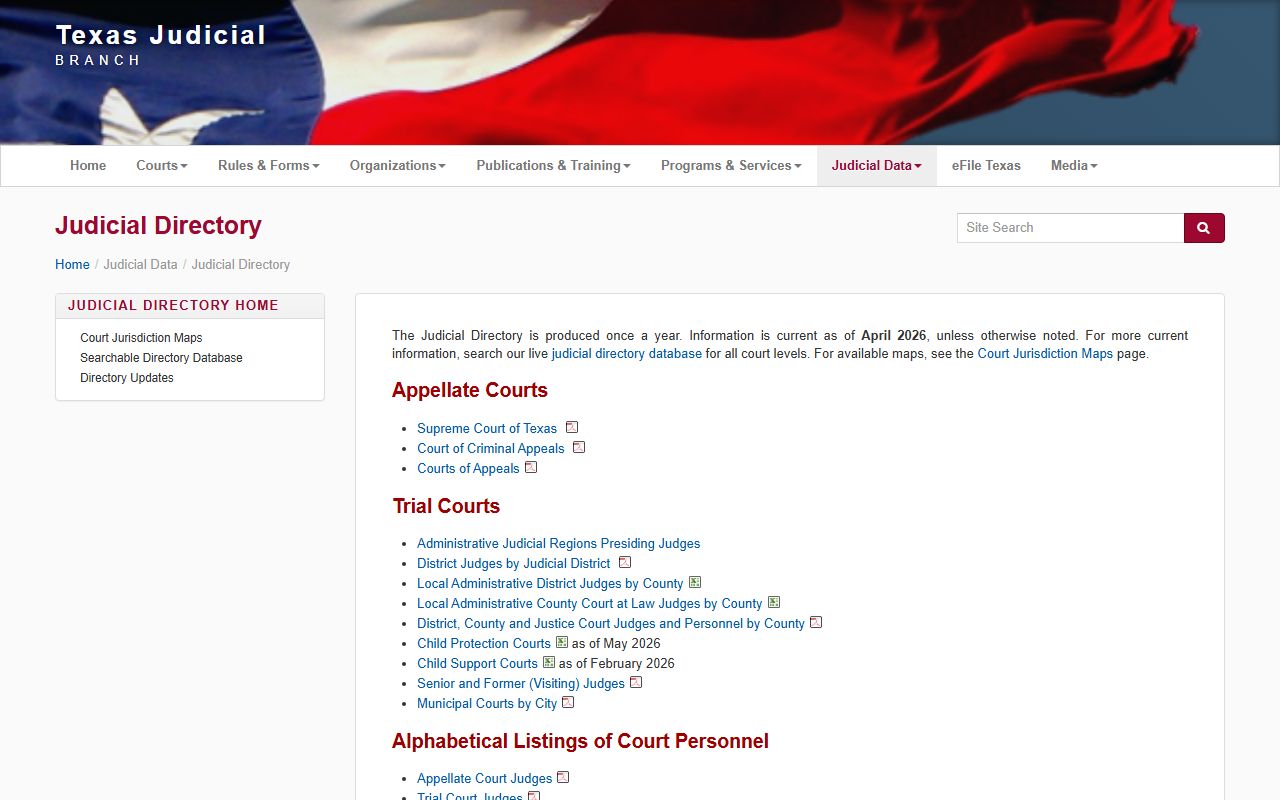
The Texas judiciary publishes a directory of these courts and their judges. The Texas judicial directory lists Galveston County district, county, justice, and municipal courts.
Because the courts share one address, the court number and judge are the quickest way to confirm which court hears a case. One local detail stands out: the 56th District Court has handled Benzene mass-tort cases transferred for pretrial proceedings, which shows up in the court portal as a special case status. It is a reminder that a single numbered court can carry specialized dockets alongside its regular work.
How to Search Galveston County District Court Records
District court case records are searched through the county's Tyler Odyssey portal. The County Clerk Records Search page links to it under Search Court Records, and Smart Search pulls case files while Search Hearings pulls hearing dates. Both are free and use a reCAPTCHA check for anonymous users.
- Open the Odyssey portal and choose Smart Search for a case record.
- Enter a case number, or a name in Last, First Middle Suffix format.
- Use Advanced Filtering Options to narrow by case status, file date, or judicial officer.
- Open a result to read the docket, then request a certified copy from the District Clerk if needed.
You can also filter by a named judge, which is useful when you know the court but not the case number. The portal's judicial-officer list names the Galveston County district judges, so you can pull a single court's docket when you are tracking a particular bench. Full search detail sits on the Galveston County court records page.
District Court vs County Court vs Justice Court
Texas spreads trial work across several court levels, and the level decides what a court can hear. District courts take the heaviest matters, county courts at law take mid-level cases, and justice courts handle small and fine-only matters. The table compares the three.
| District Court | County Court at Law | Justice Court | |
|---|---|---|---|
| Civil Cases | Major civil and family matters | Mid-level civil lawsuits | Small claims and evictions |
| Criminal Jurisdiction | Felonies | Class A and B misdemeanors | Class C, fine-only |
| Family Cases | Yes | Some family matters | No |
| Record Custodian | District Clerk | County Clerk | The JP court |
So a felony or divorce sits in district court, while a small-claims case or a traffic citation goes to a lower court.
How a Case Moves Through the Galveston County System
A case follows a path from filing to resolution, and the path differs for criminal and civil matters. The diagrams below show the usual flow through the Galveston County courts.
Criminal flow: Arrest › Magistrate / First Appearance › Indictment or Information › Arraignment › Pretrial › Trial › Sentencing › Appeal
Civil flow: Petition Filed › Answer › Discovery › Mediation › Trial › Judgment › Appeal
Felony cases reach district court by indictment from a grand jury or by information. Civil and family cases start with a petition and often pass through mediation before a final trial, a step the county courts require in many matters.
Civil, Family, and Criminal Dockets
Unlike some states, Texas does not split its district courts into fixed civil, family, and criminal divisions by name. Each Galveston County district court is a general-jurisdiction court that can carry a mixed docket. In practice, courts may weight their calendars toward certain case types, but the assignment depends on local court administration rather than a permanent division.
This matters for records. A felony, a divorce, and a major civil suit can all live in the same numbered court, so the court number alone does not tell you the case type. The case number, the parties, and the case status in the court portal give the real picture, which is why a search is more reliable than assuming a court only hears one kind of case. The Odyssey case-status list reflects this range, with values for criminal, family, juvenile, and civil matters all flowing through the Galveston County district courts.
Judicial District and the Court of Appeals
Each Galveston County district court covers a numbered judicial district. Appeals from these courts go to a Texas intermediate court of appeals, which reviews civil and criminal rulings from district and county courts. From there, civil appeals can reach the Supreme Court of Texas, and criminal appeals can reach the Texas Court of Criminal Appeals.
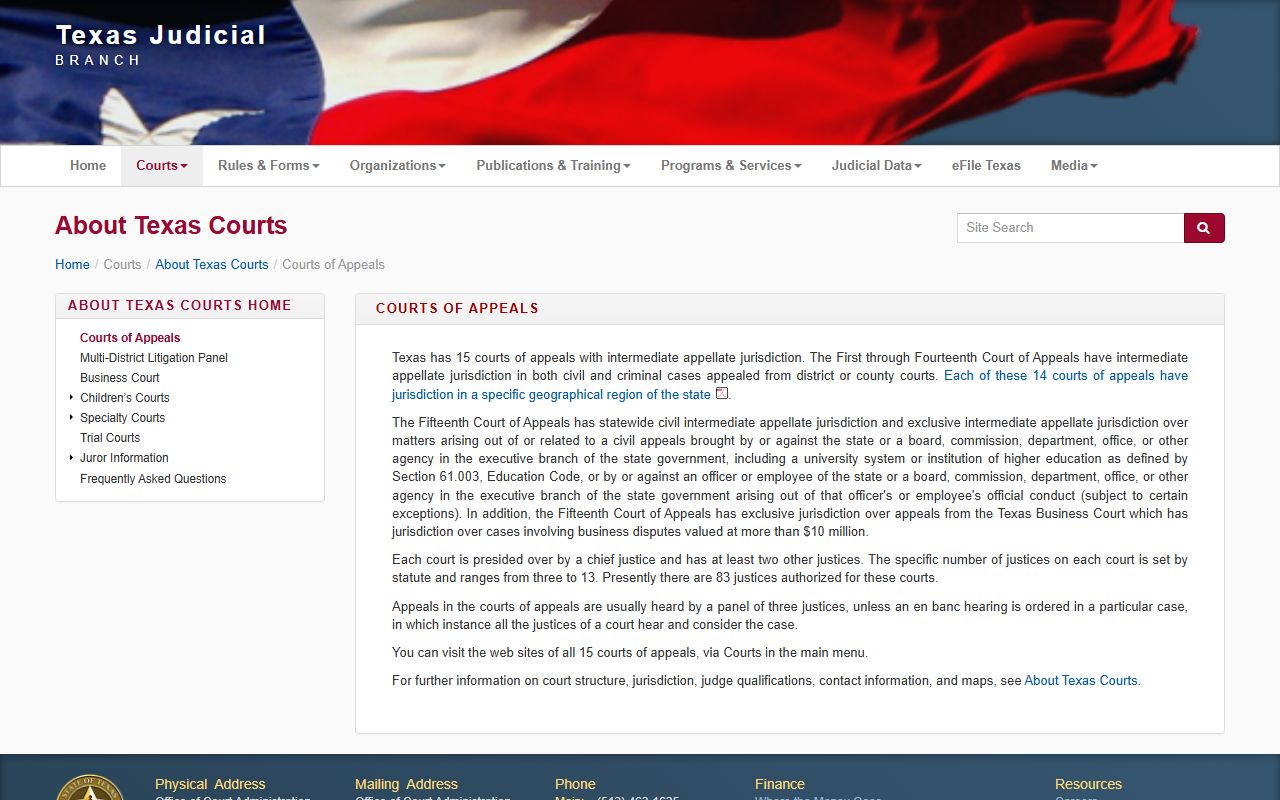
The Texas judiciary explains the appellate structure on its site. The Texas courts of appeals page describes the intermediate appellate courts that hear Galveston County appeals.
So a district court ruling is not always the last word; the appellate courts sit above it.
Magistrate and Lower Courts
Below the district courts, Galveston County runs county courts at law, a constitutional county court, justice of the peace courts by precinct, and a magistrate court. The justice courts sit in communities across the county, from Bacliff and Texas City to Galveston, Santa Fe, La Marque, Crystal Beach, and League City. A magistrate court and a jail docket handle early criminal steps such as first appearances.
These lower courts feed the district courts. A felony often begins with a magistrate or first appearance before it reaches a grand jury and a district court, while many minor cases stay in the justice or municipal courts and never move up.
The county courts at law also carry their own detailed dockets. County Court at Law No. 1 hears criminal misdemeanors, family and juvenile matters, and civil lawsuits, and County Court at Law No. 2 publishes procedures for pleas, status conferences, and mediation. Records from these courts are kept by the County Clerk, while district court records stay with the District Clerk, so the court level points you to the right clerk.
Federal Court and Appeals in Galveston County
Galveston County also sits within the federal system. Federal cases are heard in the U.S. District Court for the Southern District of Texas, which includes the Galveston Division. Federal matters are separate from the state district courts and use their own records system rather than the county portal.
Federal appeals from Galveston County go to the U.S. Court of Appeals for the Fifth Circuit. The U.S. Court of Appeals for the Fifth Circuit hears appeals from the federal district courts in Texas, including Galveston Division cases.
So a Galveston County matter can travel two separate appellate ladders, one state and one federal, depending on where it started. The two systems do not cross over, which is why a state district court case and a federal case from the same county are tracked in different records systems from start to finish.