
Arrest Records in Galveston County
An arrest record is made by a police or sheriff agency, not by a court. In Galveston County, most arrest and booking data flows through the Sheriff's Office, which runs the jail at 5700 Avenue H. When a person is booked, staff record the charge at arrest, take a booking photo, and most of the time take fingerprints. That entry is the arrest record. It can show the charge, the arrest date, and the booking agency.
A criminal court record is different. It starts when a prosecutor files charges in a court. The court file then holds pleadings, pleas, motions, and the final disposition. So arrest records and court records track the same event from two angles. Recent arrests and current custody live with the Sheriff, and full case history lives with the courts and is covered on the Galveston County court records page.
The Sheriff's P2C system has several modules, including an event search that surfaces reported events and arrests. The P2C event search is one of the public lookups the Sheriff offers.
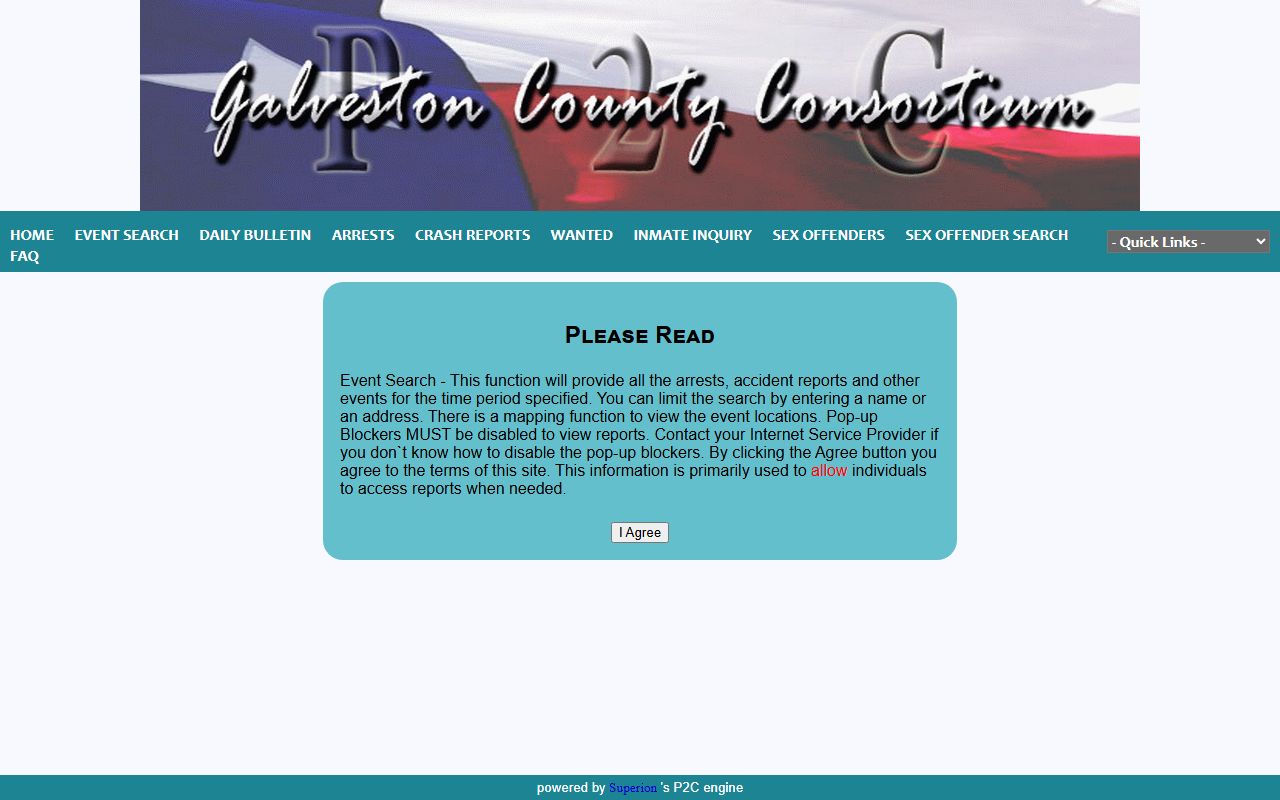
Start with the module that matches your question, because the arrest, wanted, and inmate tools each pull from a different list. The Sheriff's P2C menu links separate modules for arrests, the daily bulletin, the wanted list, inmate inquiry, and sex offender search. They are not one combined database. A person released from the Galveston County Jail may not appear in a state or federal list unless they were transferred, so a single search does not always answer "where is this person now."
How to Search Galveston County Arrest Records
The Sheriff's P2C portal is the main public tool for arrests and jail custody. A dedicated arrests module shows recent arrest activity, while the inmate inquiry shows who is in the jail right now. Both are free and run from the browser. For records the Sheriff holds as reports, the Administrative Services division takes written public-information requests by email, mail, or hand delivery.
- Open the Sheriff's P2C site and choose the arrests or inmate inquiry module.
- Enter a last name and first name, or filter the grid by date and agency.
- Review the results for charge, arrest date, and booking agency.
- Open an inmate detail row to see the booking photo, charge status, docket number, and bond.
The arrests module is built for recent booking activity. The P2C arrests search helps you find recent Galveston County arrest records by name or date.
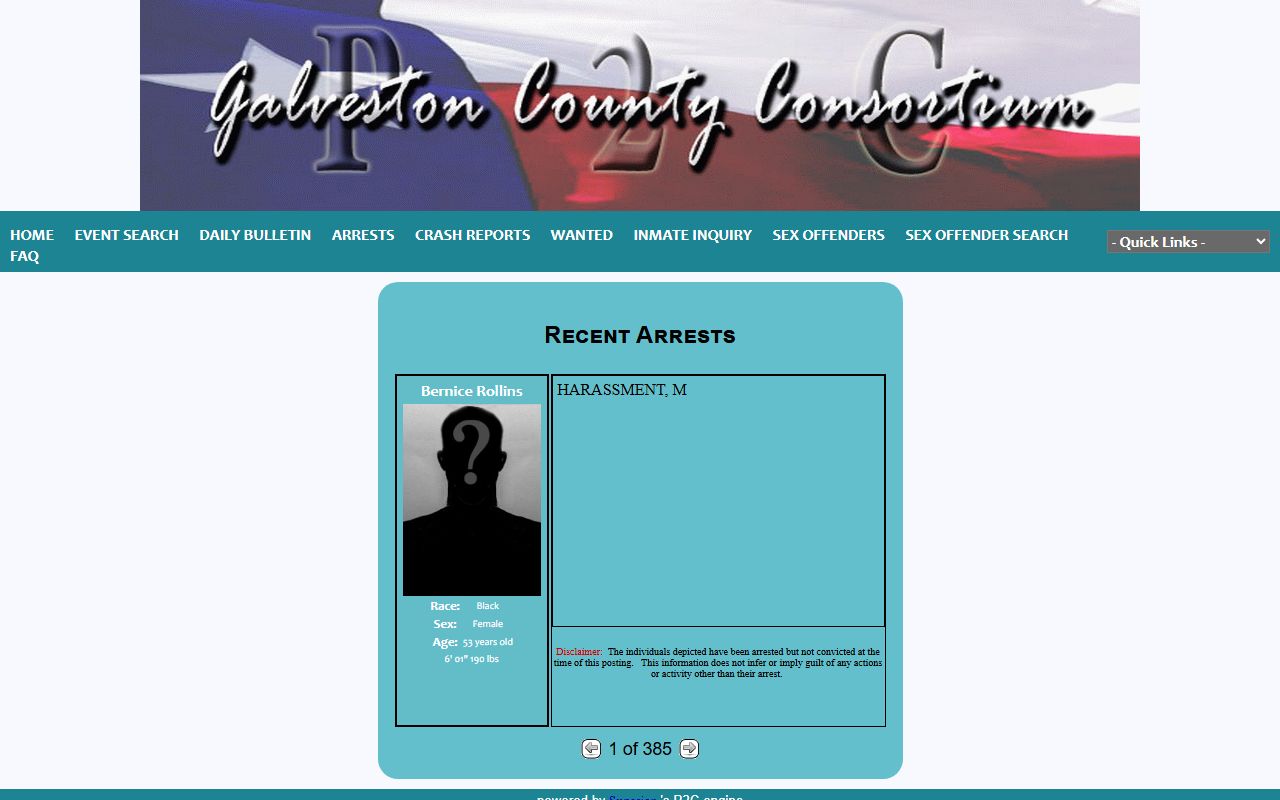
For full criminal histories beyond county booking data, the state maintains a separate criminal-records system described below.
Arrest Records vs Criminal Court Records
The clearest way to read Galveston County criminal data is to separate the arrest from the court case. An arrest happens at booking. A court record begins when charges are filed. They can carry different details and follow different rules, so one can change while the other does not.
| Arrest Record | Criminal Court Record | |
|---|---|---|
| Source | Sheriff or police | Court clerk |
| Created When | At booking | When charges are filed |
| Contents | Booking info, charge at arrest, booking photo, bond | Pleadings, motions, plea, disposition |
| Where to Find | Sheriff P2C inmate and arrest modules | Odyssey court portal and the clerk |
Who Prosecutes Criminal Cases in Galveston County
The Galveston County Criminal District Attorney's Office represents the State of Texas in criminal cases that arise anywhere in the county, except misdemeanors filed in city municipal courts. Police and sheriff agencies investigate reports, and prosecutors then file and carry the case from filing through plea, trial, dismissal, and appeal. The office says its primary duty is not to convict but to see that justice is done.
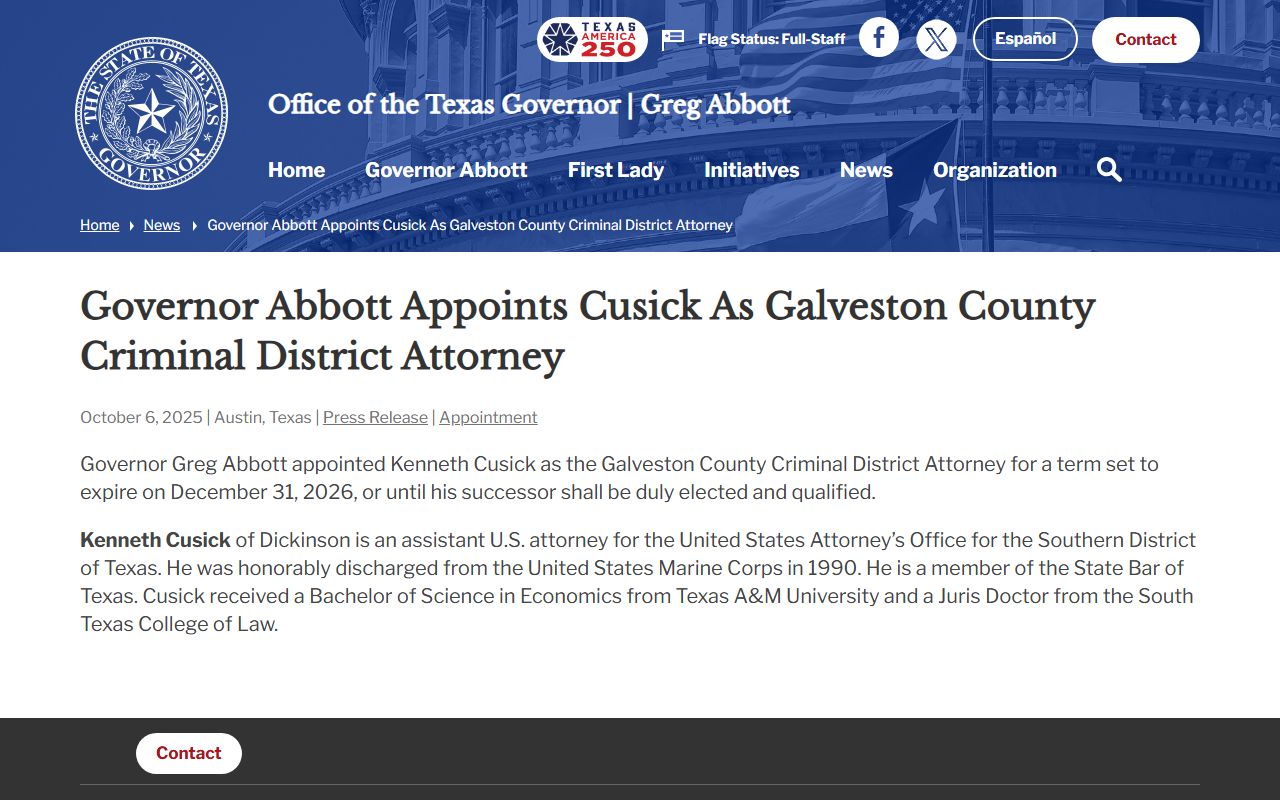
Kenneth A. Cusick is the Criminal District Attorney. Governor Abbott appointed him on October 6, 2025 for a term expiring December 31, 2026 or until a successor is elected and qualified. The office sits at 600 59th Street, Suite 1001, with a main line of (409) 766-2355, and is staffed by 46 assistant district attorneys, six investigators, and 27 support staff. Cases are filed in justice courts, county courts at law, and district courts depending on the offense.
The appointment was announced through an official state release. The Governor's appointment release sets out Cusick's background and term.
Because the DA does not prosecute city municipal misdemeanors, a citation from a city police department may route to that city's court instead.
Charges vs Convictions
A charge is an accusation. A conviction is a finding or plea of guilt. The two sit at opposite ends of a case, and many cases never cross from one to the other. A Galveston County arrest record may list a charge that is later dismissed, reduced, or resolved through deferred adjudication, so never read a charge as a conviction.
| Charge | Conviction | |
|---|---|---|
| Stage | Accusation at arrest or filing | Verdict or guilty plea |
| Burden of Proof | Probable cause | Beyond a reasonable doubt |
| Public Record | Yes | Yes, unless sealed |
| Outcome | May be dropped or reduced | Sentence or judgment imposed |
Mugshots and Booking Photos
A booking photo, often called a mugshot, is taken during the booking process at the Galveston County Jail. The Sheriff's P2C inmate detail page shows a booking image for a person in custody, served through the system's image element. The photo sits alongside the charge, status, docket number, and bond on the detail view.
Booking photos for current inmates are visible through the public inmate inquiry, but the Sheriff does not publish a separate mugshot gallery. Avoid third-party mugshot sites, which often charge removal fees and are not official. For an official image or record, use the Sheriff's own system or a written records request.
An inmate detail in the P2C system pairs the booking image with the case data. A sample current-inmate record showed the name, age, race and sex, arrest date, a release-date field, a next-court-date field, the booking photo, and a charge table with the charge, status, docket number, and bond. The sample did not show a housing pod, security classification, or arresting officer, so do not assume those fields are public.
Sealed vs Expunged Records
Texas treats sealing and expunction as two different remedies. An order of nondisclosure seals eligible criminal history from the public while leaving it open to criminal-justice agencies. An expunction removes eligible records entirely. Each has its own statute and its own eligibility, and a person may qualify for one but not the other.
| Sealed (Nondisclosure) | Expunged | |
|---|---|---|
| Visibility | Hidden from the public | Destroyed or returned, treated as if it never happened |
| Law Enforcement | Still available to criminal-justice agencies | Very limited access after the order |
| Governing Law | Government Code Chapter 411 | Code of Criminal Procedure Chapter 55 |
| Eligibility | Certain deferred adjudication and qualifying outcomes | Acquittal, pardon, some dismissals, or arrests with no charge after the wait period |
Expunction is a petition filed in the proper district court, naming the agencies that hold records and giving required notice before a judge can grant it.
Statewide Criminal Records Search
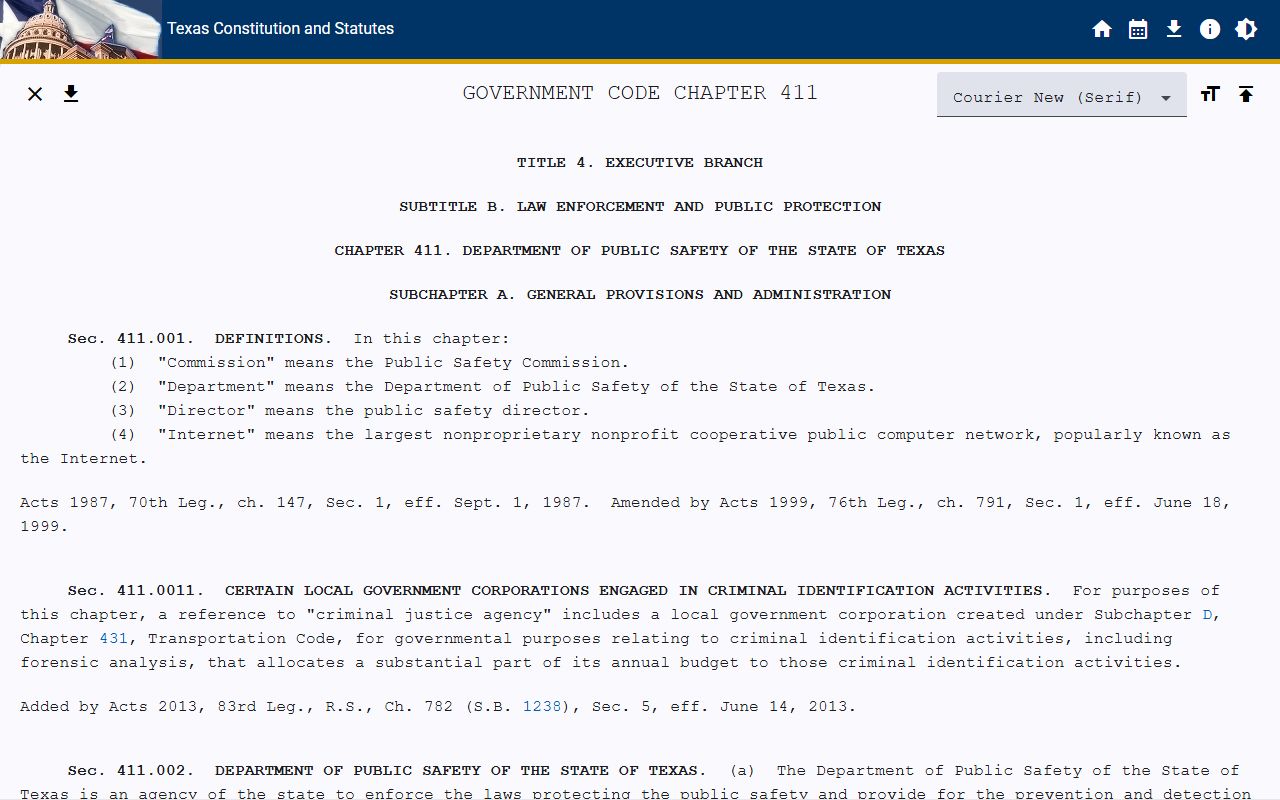
County booking data is only part of the picture. The Texas Department of Public Safety keeps statewide criminal history through its Crime Records division. State law controls who may receive criminal history and how nondisclosure orders limit it. Texas Government Code Chapter 411 governs that dissemination and the orders of nondisclosure that restrict it.
The DPS crime-records system is the state source for a formal criminal-history check, which is different from a county booking lookup. A county record shows local arrests and county court cases. A state criminal history can pull reported activity from across Texas. For felony cases, prosecutors present evidence to a grand jury, and the resulting indictment becomes part of the district court record rather than the arrest file. So a complete picture of a Galveston County matter often needs both the county systems and the state record.
Background Check Considerations
A casual name search is not a background check. A true background check that is used for credit, employment, housing, or insurance must follow the Fair Credit Reporting Act and come from a regulated consumer reporting agency. County arrest lookups and court searches are public-record tools, not FCRA reports, and they should not be used to make those decisions.
Important: This site is not an FCRA-regulated consumer reporting agency, and its information may not be used for credit, employment, tenant, or insurance decisions.
Restricted Criminal Records in Galveston County
Some criminal records are closed to the public. Juvenile justice records are restricted under Texas Family Code Chapter 58. Records covered by an expunction order must be removed, and records under nondisclosure are hidden from public view. Active investigation and prosecution files can be withheld under the law-enforcement exception in the Public Information Act, so an open case may show little detail until it resolves.
Read status apart from outcome. Labels like "Warrant Issued," "Pre-Indictment," or "Motion to Revoke" mark a stage, not a final result. Look for the disposition and judgment fields to learn how a charge actually ended.